

COAT OF ARMS OF THE CITY OF JURBARKAS
There is no information dating back to before the 17th century regarding the coat of arms of the city of Jurbarkas (if one was used at all), but it cannot be said that the city did not have any symbol prior to that time. The town’s heraldry can be inferred from the Magdeburg rights granted to Jurbarkas by Sigismund Vasa in 1611, as well as from the earliest surviving excerpts from town records, stamped with a seal bearing the symbols of Jurbarkas.
The aforementioned 1611 privilege also legally defined the symbols of the city of Jurbarkas: “<…> to seal court decisions and the documents of the townspeople, we grant them the seal of the mayor and the town council, namely three white lily blossoms on a red field, as shown more clearly here.”
Since neither the ruler’s privilege itself nor the town’s records have survived to the present day (at least their existence is currently unknown), the seal bearing the approved symbols of the town of Jurbarkas is inferred from several surviving excerpts from the town’s records. Currently, five such documents are known to bear the seal of the city of Jurbarkas: the earliest is dated July 1, 1613, and the latest is dated February 15, 1663. All of them were undoubtedly stamped with the same seal, so it can be assumed that the earliest known document was stamped with the very same seal that the town received along with the Magdeburg rights granted by the ruler on November 4, 1611.
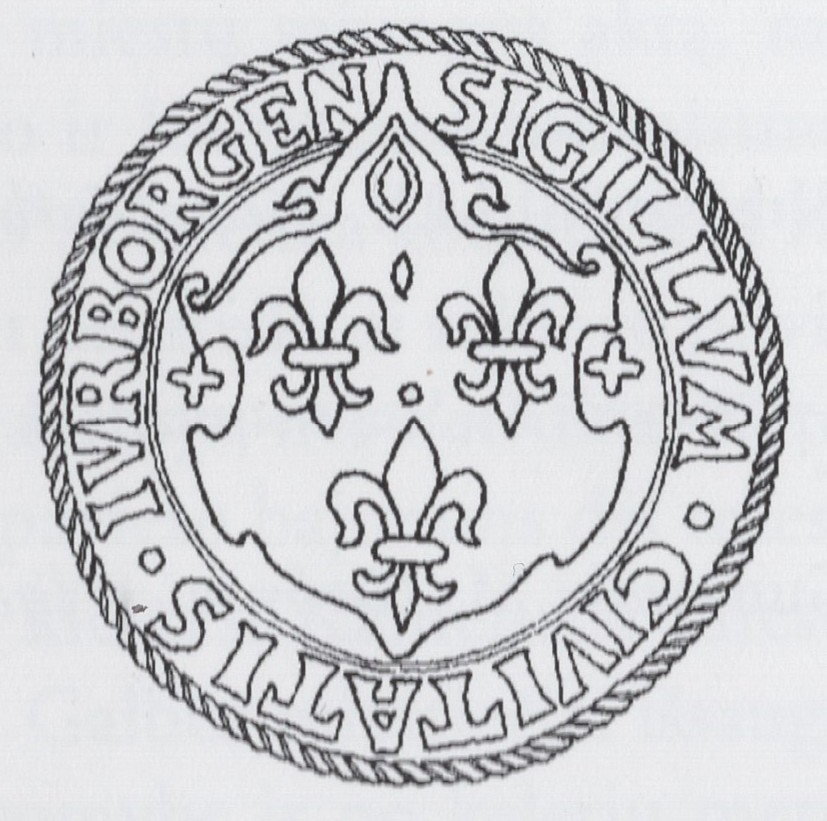
The seal of the town of Jurbarkas, found on five different extracts from the town’s record books dated 1613–1663. It is almost certain that all the extracts were stamped with the same seal, which was likely in use since the Magdeburg rights were granted in 1611. The Latin inscription reads “SIGILLVM CIVITATIS IVRBORGEN” (Seal of the City of Jurbarkas).
The seal was reconstructed by Edmundas Rimša


